
MatchOdds AI
An agentic RAG system for NBA pre-game betting analysis that aggregates statistics, injuries, odds, historical matchups, news, and sentiment signals, then compares CoT, ReAct, and multi-agent reasoning strategies for calibrated game prediction.
This project explores agentic retrieval-augmented generation for NBA pre-game betting analysis. Before tip-off, useful information is spread across fragmented sources such as injury reports, team statistics, head-to-head records, bookmaker odds, news coverage, and fan sentiment. MatchOdds AI was built to unify these signals into a structured analysis workflow that can produce evidence-grounded game predictions.
I developed an end-to-end sports intelligence system that collects, organizes, retrieves, and reasons over NBA pre-game data. The system aggregates team performance statistics, historical matchups, injury reports, odds data, news sentiment, social signals, and semantically similar historical games. These sources form a shared evidence layer that can be passed into different reasoning backends for controlled comparison.
The core retrieval layer uses a ChromaDB vector store containing embedded historical NBA game records with metadata such as team, season, home/away status, rest context, and back-to-back indicators. Given an upcoming matchup, the system retrieves similar historical games and combines them with structured tools for team stats, head-to-head records, injuries, odds, and sentiment signals.
To study how different LLM reasoning strategies behave on the same forecasting task, I implemented three interchangeable analysis methods. The chain-of-thought baseline gathers all evidence deterministically before a single structured reasoning pass. The ReAct agent decides which tools to call step by step, observes intermediate results, and then produces a final report. The multi-agent debate system separates reasoning across specialized agents, including a stats agent, matchup agent, and market agent, before synthesizing their views into a consensus prediction.
The evaluation framework backtests the system on historical NBA games using proper scoring and calibration metrics. Each method is evaluated with Brier score, log loss, expected calibration error, accuracy, precision, recall, and F1. The project also studies whether information density improves prediction quality and uses ablation experiments to measure which data sources contribute the most predictive signal.
The main empirical finding is that the simpler chain-of-thought baseline outperforms both the single ReAct agent and the multi-agent debate system across the measured metrics. This result highlights an important design lesson for agentic systems: when all relevant evidence can be gathered reliably upfront, a single structured reasoning pass may be more stable than iterative tool-calling or multi-agent coordination.
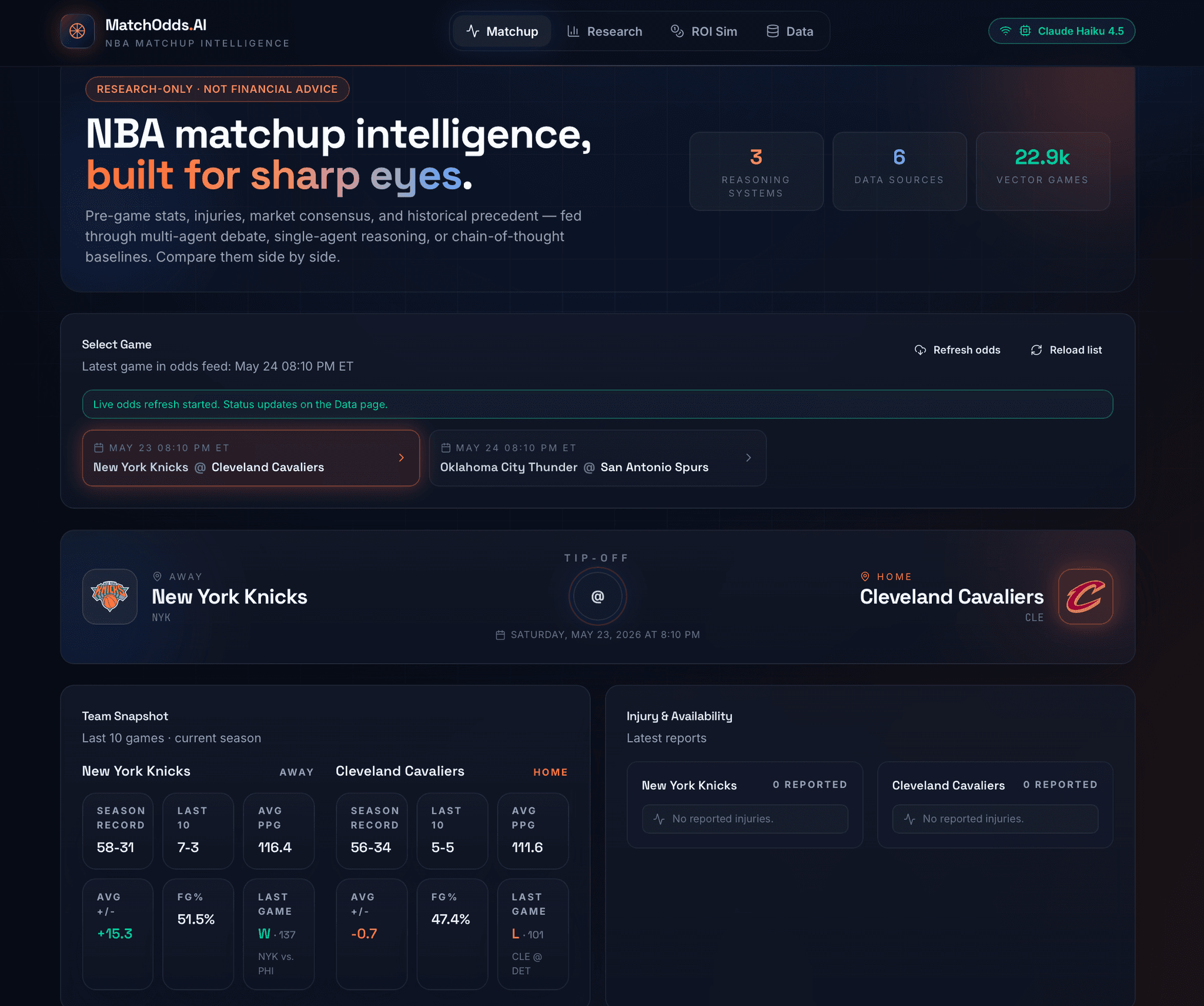
The project also includes a user-facing application for generating NBA matchup reports. The interface allows users to select a game, choose a reasoning method, and view structured outputs such as win probability, key factors, similar historical games, reasoning traces, calibration results, and evaluation charts. This makes the system both a practical betting-analysis assistant and a research platform for comparing LLM reasoning architectures.
Overall, MatchOdds AI demonstrates how retrieval, structured sports data, vector search, and LLM reasoning can be combined into an interpretable pre-game analytics system. Beyond predicting winners, the project shows how agent design, evidence availability, calibration, and output consistency affect the reliability of LLM-powered decision systems in high-noise forecasting tasks.