
Dynamic Resource Allocation in Cloud Computing
A power-aware, SLA-bound deep reinforcement learning scheduler for cloud computing, built with a custom Gymnasium simulator, PyTorch RL agents, FastAPI orchestration, and a React monitoring dashboard.
This project explores dynamic resource allocation in cloud computing, where queued jobs must be assigned to heterogeneous servers while balancing two competing objectives: reducing cluster power consumption and satisfying SLA latency deadlines. Since server power is non-linear with respect to utilization, simple scheduling heuristics can miss important long-horizon trade-offs between energy efficiency, queue pressure, and deadline violations.
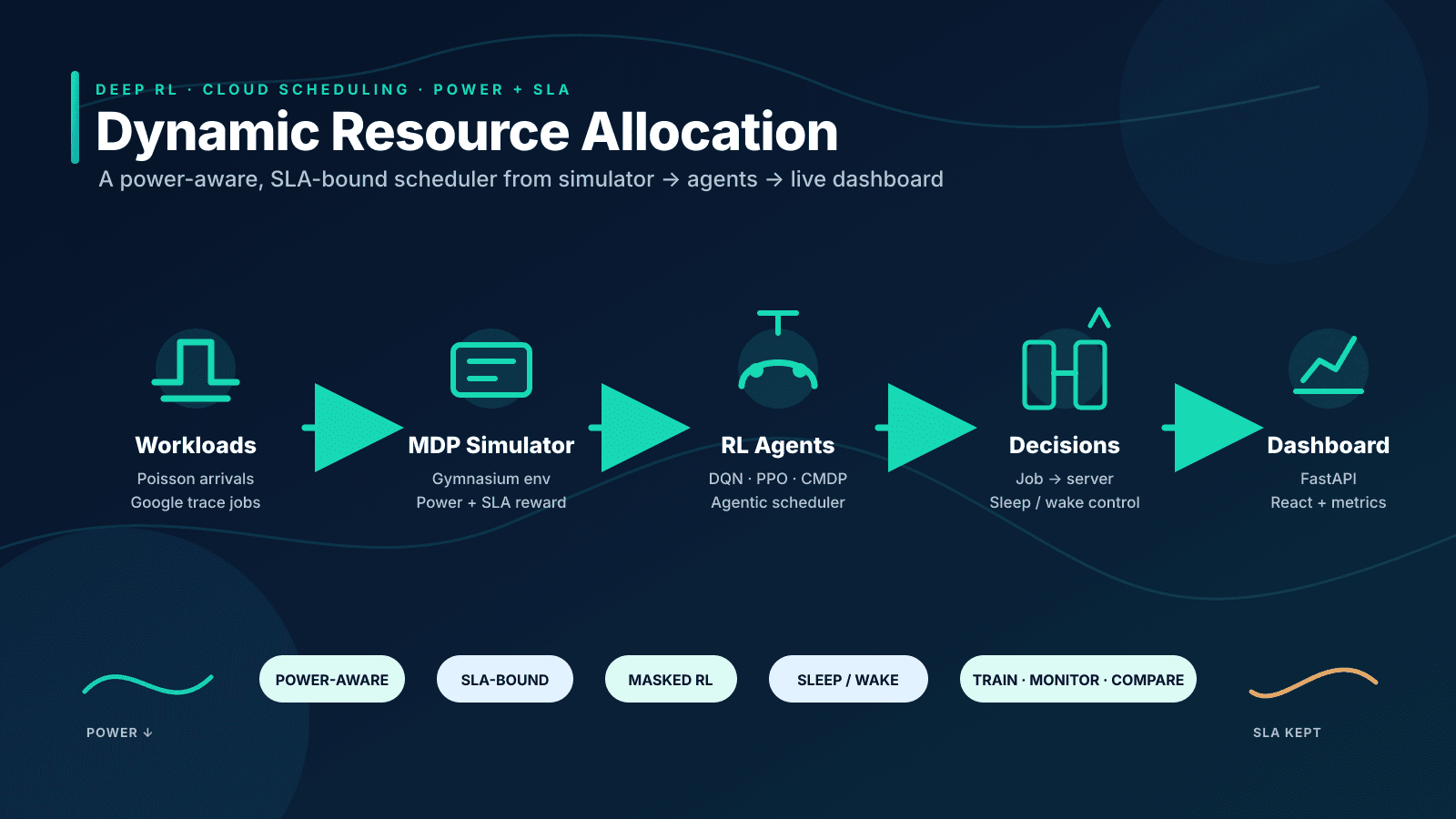
I built an end-to-end reinforcement learning system that models the cloud cluster as a discrete-time Markov Decision Process. The custom Gymnasium environment represents server utilization, memory usage, power capacity, queued job requirements, job duration, and wait time. At each step, the scheduler decides which queued job should run on which server, or whether the system should wait when no valid placement exists.
The core environment uses a heterogeneous server fleet with efficient, standard, and power-hungry machine tiers. The action space jointly combines queue-slot selection and server placement, while invalid-action masking ensures that infeasible job-server assignments are blocked both during action selection and during value-target computation. The reward function combines normalized active power with SLA violation signals and continuous queue-pressure shaping, allowing the agent to learn before deadlines are actually missed.
I implemented and compared multiple scheduling agents across different reinforcement learning paradigms. The system includes a Double DQN agent for discrete off-policy control, a PPO actor-critic agent for stable on-policy learning, a hierarchical agentic-RL scheduler with separate power and SLA sub-agents supervised by a learned arbitrator, and a Lagrangian CMDP-style offline agent that treats SLA violations as a constrained cost rather than only a soft reward penalty.
The project also extends the baseline scheduler with sleep and wake server actions. In this setting, servers can be placed into a low-power standby state and later reactivated with a wake-up delay. This changes the scheduling problem from pure placement into true power-aware control: the agent must decide not only where to place jobs, but also when to keep capacity active, when to save energy, and how to avoid violating SLA constraints during workload bursts.
To make experiments reproducible, I designed a full evaluation harness with train/test seed splits, deterministic heterogeneous fleets, synthetic Poisson workloads, Google trace-sampled workloads, baseline heuristics, logging, and held-out greedy evaluation. The system reports reward, power consumption, SLA violation rate, and power-SLA trade-offs across learned agents and classical baselines such as Shortest Job First, First-Fit Decreasing, and Round Robin.
Beyond the RL engine, the project includes a full-stack experimentation interface. A FastAPI backend orchestrates training jobs, a SQLite store persists run metadata and metrics, WebSockets stream live training updates, and a React dashboard visualizes training curves, power usage, SLA violations, and model comparisons through interactive Recharts components.
Overall, this project demonstrates how deep reinforcement learning can be used to build a practical, monitorable, and extensible cloud scheduling system. Instead of treating resource allocation as a static heuristic problem, the framework learns policies that adapt to bursty workloads, heterogeneous infrastructure, non-linear power behavior, and explicit SLA constraints.