
Data Valuation for Sparse Surface Ocean Carbon Data
A Shapley-based data valuation pipeline for sparse surface ocean carbon prediction, ranking climate and Earth system data sources by their marginal contribution to regional fCO₂ prediction performance.
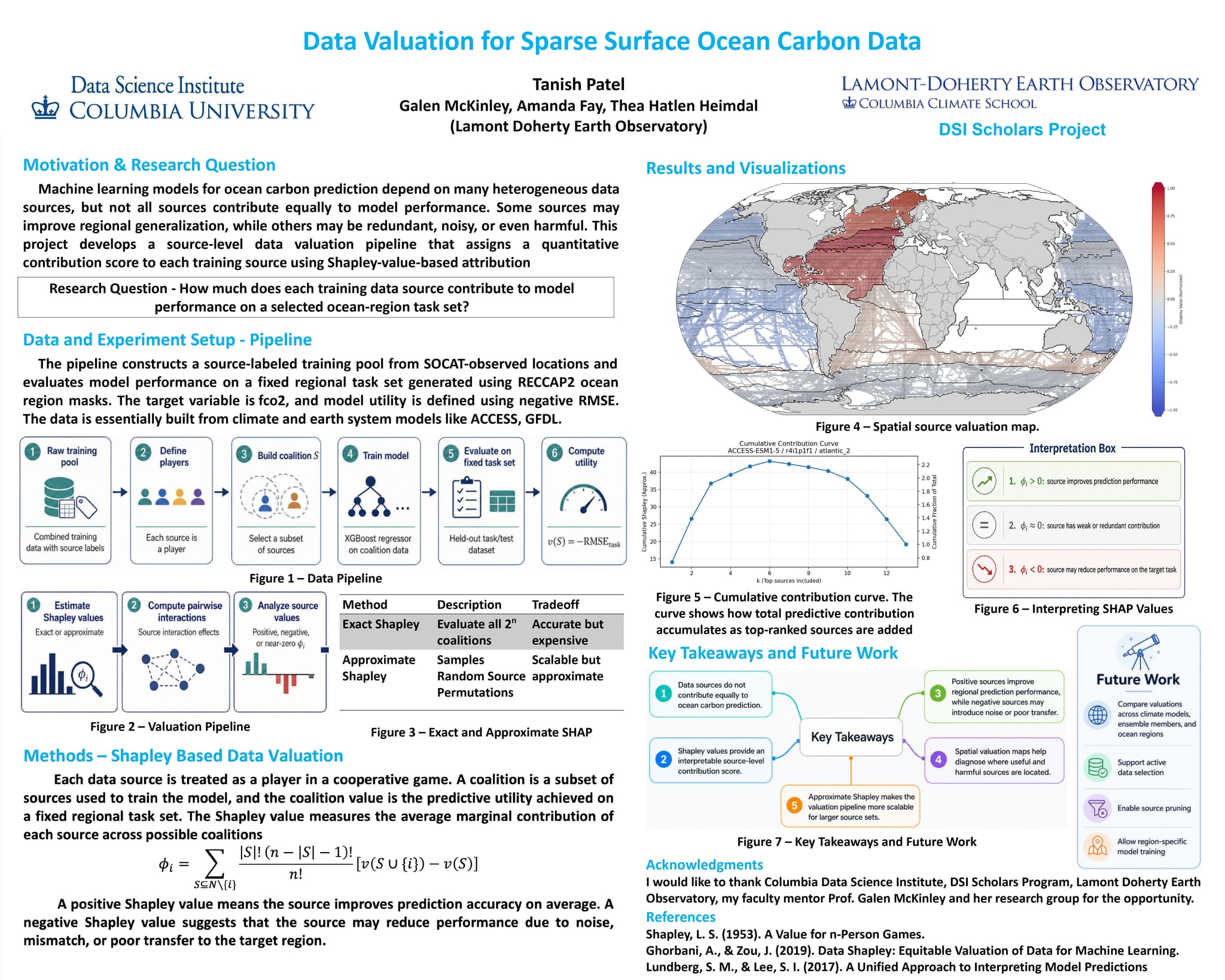
This project explores data valuation for sparse surface ocean carbon prediction. The ocean surface is vast, but direct surface carbon observations cover only a small fraction of the full ocean domain. This sparsity creates an important modeling question: when training machine learning models with multiple climate and Earth system data sources, which sources are actually helping prediction, and which may be weak, redundant, or harmful?
I developed an end-to-end source-level valuation pipeline that treats each data source as a player in a cooperative game. The pipeline builds source-labeled training pools, generates fixed regional task sets using ocean-region masks, trains models on different source coalitions, and evaluates each coalition using negative RMSE on the target task set. This makes it possible to measure how much each source contributes to regional fCO₂ prediction performance.
The core modeling engine uses an XGBoost regressor trained repeatedly on coalitions of sources. For each coalition S, the utility function is defined as v(S) = -RMSE on a fixed regional evaluation set. Higher utility therefore corresponds to lower prediction error. This setup allows source contribution to be measured in terms of actual downstream predictive value rather than simple data volume.
To assign credit fairly, I implemented both exact and approximate Shapley valuation. Exact Shapley evaluates all 2ⁿ possible source coalitions, while approximate Shapley uses Monte Carlo permutation sampling to estimate average marginal contribution more scalably. A positive Shapley value indicates that a source improves prediction performance, a near-zero value suggests weak or redundant contribution, and a negative value indicates that the source may introduce noise, mismatch, or poor transfer to the selected target region.
The project also includes a full visualization workflow. It generates spatial source valuation maps, cumulative contribution curves, coalition-size utility diagnostics, source-ranking plots, and interpretation figures. These visualizations show that data value is not uniformly distributed: a small number of sources can contribute strongly to regional prediction, while others may add little value or reduce performance.
Overall, this project demonstrates how Shapley-based data valuation can make geoscientific machine learning pipelines more interpretable and selective. Instead of treating all available training data as equally useful, the framework provides a principled way to rank, diagnose, and visualize which data sources matter most for sparse ocean carbon prediction.